Energy and brain
Of all the organs in the human body, the brain consumes the most energy relative to its weight. The human brain accounts for about 2 percent of body weight, but requires about 20 percent of the body's total energy needs.
As is well known, the energy required for the cells is generated in the mitochondria by burning sugar (cellular respiration). This process produces energy molecules (ATP) but also free radicals, which are normally kept in balance by the body's own antioxidants. 90% of the free radicals in the body are produced during cellular respiration. In the aging process, cellular respiration is weakened, and in addition pollutants from the environment accumulate so that
- Lack of energy and
- oxidative stress (more free radicals than antioxidants) arise.
Als Folge degenerieren die Zellen, verlieren ihre Funktion, die Gewebeintegrität geht verloren und der körperliche Abbau beginnt. Diese Schwächung des Energiestoffwechsels kann sich mit zunehmenden Lebensjahren im Gehirn besonders bemerkbar machen und dazu führen, dass Gehirnzellen langsam absterben.
In the short term, the undersupply of the brain can lead to symptoms such as headaches and fatigue. However, if the brain suffers from long-term energy deficiency and oxidative stress, severe neurodegenerative diseases such as Alzheimer's or Parkinson's may develop.
How can coconut oil help?
Instead of glucose, coconut oil can provide an alternative clean fuel for the mitochondria, namely ketones. From ketones, mitochondria can produce energy with high efficiency and less waste. This makes more energy available to brain cells with reduced oxidative stress.
Normale Öle und Fette bestehen aus grossen Molekülen, sie sind langkettig. Im Gegensatz dazu hat Kokosöl einen grossen Anteil, nämlich 62% kleinerer Moleküle, sogenannte mittelkettige Fettsäuren (Laurin, Capryl und Caprin). Diese können direkt durch die Darmwand in die Pfortader der Leber transportiert, dort zu Ketonen verwandelt, in den Blutstrom übergeben, rasch ins Gehirn gelangen und dort die benötigte Energie für die Nervenzellen erzeugen. Langkettige Fettsäuren hingegen werden in der Darmwand umgewandelt, ans Blut übergeben und zirkulieren im ganzen Körper.
Mittelkettige Fettsäuren haben somit folgende Vorteile
- sind eine schnelle und einfache Nahrungsquelle da sie vom Darm direkt zur Leber transportiert und dort zu Ketonen umgewandelt werden. Das heisst, sie brauchen zur Verdauung weder Bauchspeicheldrüse-Enzyme noch Gallenflüssigkeit
- Sind leichter verdaulich und besser wasserlöslich als andere Öle
- Falls nicht benötigt, werden sie im Urin ausgeschieden; sie werden nicht in Fettzellen abgelagert und verstopfen keine Arterien
- Alle Zellen, ob innerhalb oder an der Oberfläche des Körpers können mittelkettige Fettsäuren absorbieren und Energie erzeugen, also ist Kokosöl auch bei Hautproblemen, Schuppenflechte, Leberflecken, usw. anwendbar.
Anwendung Kokosöl
- Maintenance dose: 2-3 tbsp/day (e.g. for prevention of neurodegenerative problems).
- Therapeutic dose: 5 tbsp/day or more (e.g., for signs of Alzheimer's disease).
Es gibt keine Grenze, aber falls Nebenwirkungen wie Durchfall und Unwohlsein im Darm auftreten, reduzieren und langsam daran gewöhnen.
Application MCT (Medium Chain Triglycerides)
Enthält nur die mittelkettigen Fettsäuren der Kokosnuss. Empfehlenswert, da keine Belastung mit langkettigen Fettsäuren, die auch im Kokosöl enthalten sind. Geruchlos und geschmacksneutral.
- Maintenance dose: 1 tsp per meal, start slowly
- Therapeutic dose: 2 tsp. per meal (e.g. in case of signs of Alzheimer's disease).
Wirkt sehr schnell, also nicht abends einnehmen (zu wach um einzuschlafen). Bei Lebererkrankungen oder Leberkrebs nicht verwenden. Falls Nebenwirkungen wie Durchfall und Unwohlsein im Darm auftreten, reduzieren und langsam daran gewöhnen.
Um die Zuckereinnahme zu reduzieren wird empfohlen anstatt ein Dessert einen Teelöffel MCT einzunehmen.
Zusammensetzung der Fettsäuren bei Kokosöl, Butter und Olivenöl

SCFA: Short Chain Fatty Acid,
MCFA: Medium Chain Fatty Acid,
LCFA: Long Chain Fatty Acid,
C stands for carbon atoms, C4:0 means 4 carbon atoms, 0 means saturated
1 monounsaturated, 2 or 3 polyunsaturated
Fettsäurenstoffwechsel
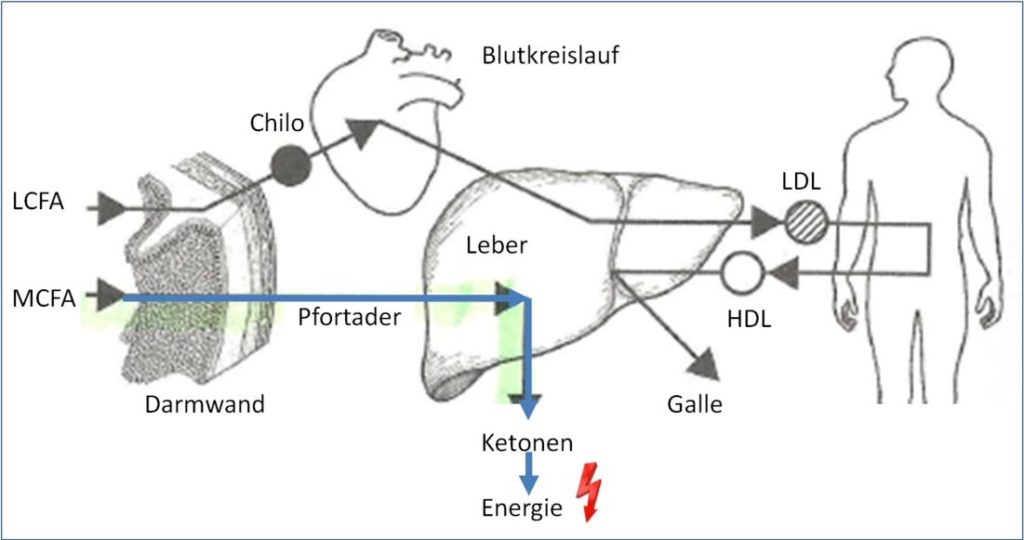
Long-chain fatty acids (LCFA) are absorbed in the intestinal wall and combined with cholesterol and protein combined into chilomicrons and released into the bloodstream and later converted into LDL (low-density lipoproteins) and circulate throughout the body as a component of lipoproteins. HDL absorbs excess cholesterol from cells and transports it to the liver, where it is excreted through the bile. Medium-chain fatty acids (MCFA), on the other hand, are transported through the intestinal wall to the portal vein of the liver, where they are used to produce ketones.