Chlorine dioxide is a oxidant, which kills (oxidizes) all harmful (pathogenic) bacteria, viruses, parasites, worms, fungi and acid cells in humans after only a few minutes and transports them out of the body naturally. It also overcomes the blood-brain barrier.
Chlorine dioxide eliminates all pathogens that are not in equilibrium with the pH of the body, but live in an acidic environment. The effect is further enhanced if the pathogens live in the absence of oxygen (anaerobic), which is both true in cancer. The elimination of the pathogens occurs by oxidation (combustion) and not by toxin (as in chemo).
Oxidation
In the chemical process of oxidation, oxygen reacts with a substance, which can
- Slowly proceed by the action of water or air, e.g., in the rusting of metals
or - Schnell passieren durch Verbrennung, wobei Wärme (Energie) freigesetzt wird (tritt bei Elementen auf die Wasserstoff oder Kohlenstoff enthalten).
Bei der Oxidation verliert die oxidierte Substanz Elektronen. Die Elektronen verhalten sich wie ein «Klebstoff» der die Struktur der Substanz zusammenhält. Wenn also die oxidierte Substanz Elektronen verliert, verliert sie auch ihre Struktur (Eisenstab -> Rost) und zerfällt.
- Toxins and heavy metals are broken down through their oxidation
A special case is the reduction oxidation (redox). Here, an interaction between the oxidizing and the oxidized (reduced by electrons) element takes place. This process occurs with chlorine dioxide!
- Chlordioxid oxidiert den Krankheitserreger, indem es ihm Elektronen wegnimmt, anschliessend zerfällt es in Wasser, Sauerstoff und minimal Salz
The pathogen is oxidized, i.e. it loses electrons and loses its effect (reduction element).
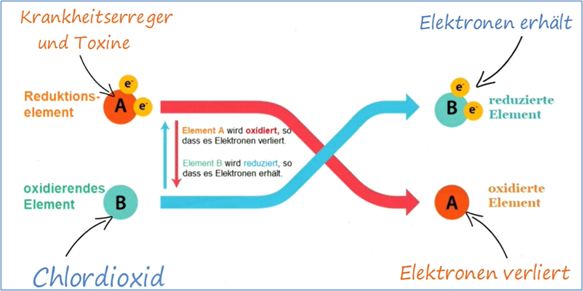
Chlordioxid bleibt im Körper nicht länger als zwei Stunden aktiv, danach zerfällt es zu Wasser, etwas Salz und Sauerstoff (was den Bauch etwas aufblähen lässt).
Krankheitserreger, die durch die Anwendung von Chlordioxid abgetötet werden, können den Körper nur über die Leber verlassen, die sie abbaut. Bei einer intensiven Behandlung kann eine vorübergehende Übelkeit auftreten. Übelkeit oder Durchfall ist ein Zeichen dafür, dass Chlordioxid mehr Erreger abtötet, als abgebaut werden können. In diesem Fall einen Tag aussetzen und anschliessend mit kleinerer Dosis wieder beginnen.
Chlordioxid – pH-Wert und Blut
Der pH-Wert (Wasserstoffpotential) wird zur Messung des Säure- oder Alkalinitätsgrades einer Flüssigkeit verwendet. Er reicht von 0 (sauer) bis 14 (alkalisch), um 7 ist er neutral.
- Das Körperblut ist im Normalfall leicht alkalisch 7.3 -7.4
- Sauerstoff ist die Hauptquelle für die Alkalisierung, hilft metabolischen Säuregehalt zu bekämpfen
- Die roten Blutkörperchen geben den Sauerstoff an die säurehaltigsten Stellen im Körper ab, um den Bereich zu alkalisieren und einen optimalen pH-Wert zu erhalten (z.B. in den Muskeln beim Training)
- Chlordioxid tut genau das Gleiche, es geht an die säurehaltigsten Stellen, um den pH auszugleichen. Aber Chlordioxid gelangt selbst dorthin, wo das Blut nicht mehr hinkommt, da es extrem klein und wasserlöslich ist und der Körper zu 70% aus Wasser besteht.
DMSO (dimenthyl sulfoxide)
DMSO is a natural sulfur compound that decisively improves the effectiveness of many remedies. As a transmitter, DMSO transports the active ingredients faster and deeper into the body and into the cells, such as in the internal and external chlorine dioxide applications. DMSO has a draining, anti-inflammatory and analgesic effect, and helps with circulatory disorders, inflammation, skin rashes, allergies, psoriasis, neurodermatitis, joint and muscle pain, open wounds and promotes wound and scar healing.